coprod raises $6M to make robot hardware as easy to build as software.
The Swiss startup has built the tech stack required to integrate hardware faster, cutting the time and resources needed for robotics development.
coprod teamengineering · research
Funding will go towards a new hardware prototyping facility in Lausanne and towards bringing to market coprod's robotic hardware stack, enabling the development of robots with form factors optimized to perform specific tasks.
LAUSANNE, 23 November 2026. coprod Inc, which builds hardware components for robotics and physical AI applications, today announced a $6M pre-seed round to reduce the time and costs associated with building a novel robotic platform. The round was led by Founderful and PROTOTYPE and includes additional investment from General Catalyst, Pace Ventures, Tiny Supercomputer Investment Company, Kima Ventures, SDAC, Unruly Capital and Venturekick, with participation from angel investors Thomas Wolf, founder of Hugging Face, the Dassault Family, Florent Perrichon and other renowned angels.
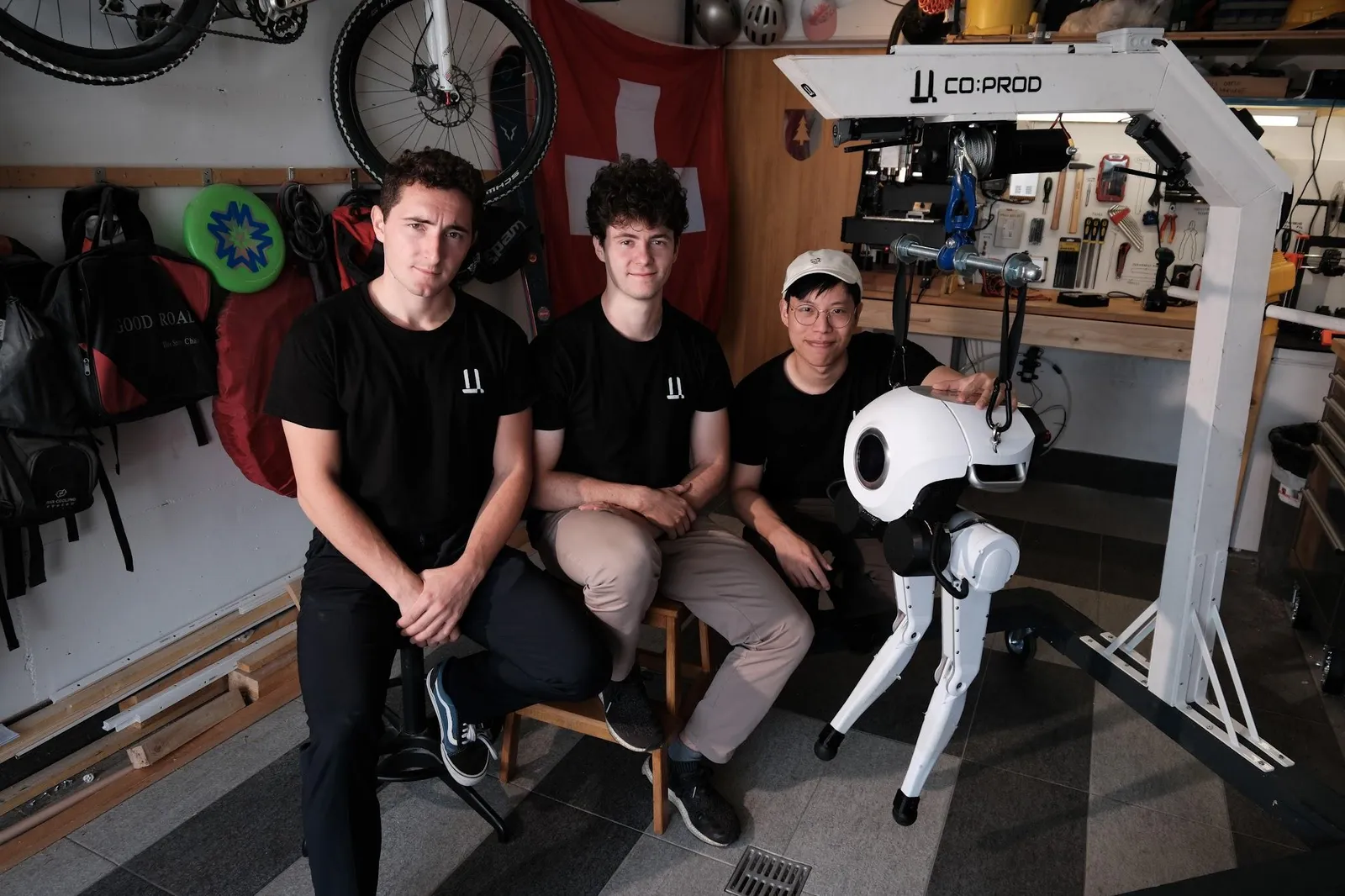
The founders, Loïc, Vincent and Matthias, with the bipedal demonstrator.
The compatible hardware components which the company calls "co:products" are already powering multiple robots in the Swiss ecosystem, notably the first student-built Swiss humanoid robot created by the ETH Robotics Club, which took its first steps a couple of weeks ago in Zurich. The company is currently establishing new partnerships with other robotics integrators and well-known labs to validate the first hardware prototypes before launching them on the market early next year.
Developing a robot with custom hardware tailored to doing a certain task quickly, cost-effectively and precisely requires considerable capital, two to three years of work and dozens of domain-specific expert engineers. With coprod's stack, the same work only requires a small team of great roboticists, USD 5,000 to 25,000 per design iteration, and a few months of time.
coprod's ecosystem of hardware components for physical AI applications works alongside a seamless software API and front-end configuration tool that interconnects those components and standardises the communication between them, while preserving the real-time performance required for safe, performant and reliable hardware. The founders are graduates of the École polytechnique fédérale de Lausanne (EPFL) and formed coprod in late 2024 to address the lack of compatibility between robotics components. They started out by building a bipedal robot demonstrator in their parents' garage deep in the Swiss Alps to show the potential of such compatible components.
Integration hell
According to recent McKinsey analysis, humanoids are currently being constrained by the underlying component supply chain, which is leading to throttled production at companies like Figure AI and Tesla (Optimus division). McKinsey estimates that the development of the specialized actuators, sensors and control systems required for humanoid applications, such as those that coprod is developing in Switzerland, could generate a $28 billion market by 2030, with potential gross margins exceeding 60% on component sales.
Most component suppliers support many protocols in the hope of suiting any integrator, but that flexibility means their parts rarely work together out of the box. Building a system from mix-and-match components puts a heavy burden on the integrator, often two to three years of custom electronics and tailored software work. Integrators must comb through lengthy datasheets, then test, debug and validate every interface before the system is reliable. This phase, known in the industry as "integration hell", is one of the most time-consuming stages of product development.
A prototyping facility in Lausanne
The round will be used to bring to market the first line of components and to develop a world-class hardware prototyping facility in Lausanne. This full-stack workshop will accelerate the company's development cycles from two weeks down to 24 hours, thanks to heavy machinery such as CNC lathes, mills, lasers, and electronic assembly and testing equipment. The testing equipment will enable coprod to provide each component with comprehensive datasheets and digital-twin models, to narrow the sim-to-real gap that arises during robotics development.
By the end of 2027, the company plans to have the entire component line on the market, qualified, certified and packaged. Large-scale production will happen both in Shenzhen and in Texas to provide domestically resilient supply chains for each market, with the headquarters, the core team and R&D remaining in Switzerland, home of precision manufacturing for the past 400 years.
What they said
Loïc Delineau, CEO and co-founder of coprod: "We believe that a robot with purpose-built hardware designed for a specific task will do that task faster, cheaper and more reliably than any general-purpose robot ever could, regardless of which model runs on it. We see robotics as just another tool that humans should be able to leverage to improve their daily lives. This starts by empowering them to build those robots by abstracting away complexity, and coprod is offering this fertile ground."
Andreas Klinger, Investor at PROTOTYPE: "The robotics revolution is real and we will be able to rethink every industry because of it. coprod is fixing the biggest problem in hardware: integration hell. Robotics founders need a single standard for basic components and middleware that simply works and allows them to focus on the parts of their product that create value for their customers as quickly as possible."
Alex Stöckl, General Partner at Founderful: "Backing Loïc, Vincent and Matthias was a no-brainer. The combination of relentless drive, deep technical expertise and global ambition is second to none. With Founderful we back founder teams building global leaders from Switzerland. In which category, if not precision manufacturing and supply of high-tech parts, is this the right place in the world to build?"
About coprod Inc.
coprod is a Swiss robotics hardware company founded in 2024. It builds modular robotics components and a unified software stack, the co:system, which combines them on a single real-time EtherCAT control plane with one API in C++ and Python. The product family includes co:power, co:battery, co:sense and co:motion. Each module can be used as part of a complete system or integrated on its own.
 coprod teamengineering · research